


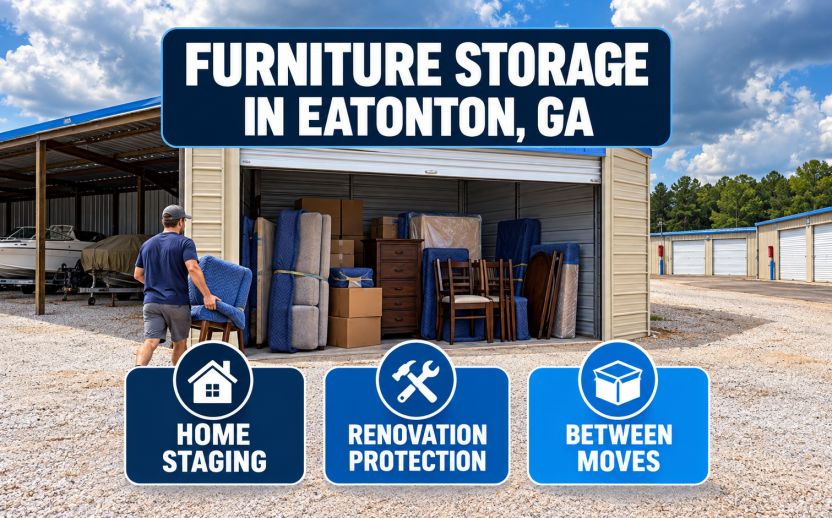
A dining set, a bedroom suite, or a sectional couch takes up more room than most people expect once it is out of its usual spot. Furniture does not shrink to fit a closet, and it does not do well stacked in a garage corner for months at a time. Store Southern gives Eatonton renters and homeowners a place to put furniture that needs to come out of a room now but is not ready to be sold, donated, or thrown away.
At a Glance
Furniture is one of the few categories where unit size genuinely drives the decision, since a sectional or a bedroom set can fill a 10x10 before boxes even enter the picture.
Store Southern units are rented month to month, so furniture can come out of storage as soon as a renovation finishes, a sale closes, or a room is ready for it again, without waiting out a fixed lease term.
Why Furniture Ends Up in Storage More Than Most Belongings
Furniture gets stored for reasons that are different from the usual seasonal clutter or extra boxes. It is often mid transition: pulled out of a room that is being painted or re floored, inherited from a relative and not yet placed anywhere, or left over after a move where the new place is smaller than the old one. None of those situations call for getting rid of the furniture outright, and none of them have a fixed end date known in advance. A month to month unit fits that uncertainty better than committing to a long lease or trying to make it work in a garage that was not built for long term storage.
What a Renovation Actually Displaces
A kitchen or living room remodel does not just displace a table and chairs. It usually means clearing an entire room, sometimes two, for weeks at a time while contractors work. Furniture sitting in a hallway or a spare bedroom gets in the way of the work itself and risks dust or damage from construction debris. Moving it into a unit at Store Southern clears the space completely and keeps the furniture out of the job site until the room is ready again.
Selling a House With Furniture Still in It
Staging a home for sale often means removing furniture rather than adding it. A room reads larger and shows better with less in it, but the furniture being removed still needs somewhere to go until the sale closes and the new place is ready. Short term storage is built for exactly that kind of window, where the end date is close but not fixed to the day.
Furniture From a Combined or Split Household
When two households combine into one, or one splits into two, furniture rarely divides evenly or immediately. Extra pieces that are not needed right away but are not ready to part with either end up taking space that was meant for something else. Storing the overflow for a few months while the new living situation settles is a more practical first step than making a permanent decision under pressure.
Protecting Furniture While It Sits
Furniture behaves differently in storage than boxes do. Upholstery, wood finishes, and veneer are more sensitive to how they are packed and positioned than they are to any single feature of a unit. A few things matter more than people expect: keeping fabric off a concrete floor with a pallet or plastic sheeting, standing mattresses on edge rather than stacking weight on top of them, and leaving a little airflow around large pieces rather than pushing everything flush against a wall. None of this requires special equipment, just attention before the unit door closes.
What Drive Up Access Changes for Heavy Pieces
Furniture is heavy and awkward, which makes the path from the truck to the unit matter as much as the unit itself. Drive up storage means a couch or a dresser goes straight from a truck ramp into the unit without a hallway, an elevator, or a long walk in between. For anyone moving furniture without a full crew, that shorter path is often the difference between a manageable afternoon and a genuinely hard one.
Sizing a Unit Around Furniture, Not Boxes
Furniture fills space differently than boxes do, so a unit that would hold plenty of boxes can run out of room fast once a couch and a bedroom set are added in. A single large piece, like a sectional or a sleigh bed, can take up a meaningful share of a 10x10 on its own. A 10x15 or 10x20 gives enough room to stand pieces on end, leave walking space, and still fit boxes or smaller items around the edges. The sizing guide walks through what actually fits at each size before you commit to one.
Frequently Asked Questions
Do I need to disassemble furniture before storing it? It depends on the piece, but breaking down bed frames and table legs usually saves enough space to be worth the extra time.
How long can furniture stay in a unit? As long as you need, since units are rented month to month with no fixed end date.
Will my furniture be safe from moisture or temperature swings? Storage conditions vary by unit type, so ask at the time you reserve what is appropriate for the specific pieces you are storing.
Can I access my unit to rearrange or check on furniture during a long stay? Yes, within the facility’s posted access hours.
Reserve a Furniture Storage Unit in Eatonton
Between renovations, moves, and households that change shape, furniture ends up needing a temporary home more often than most belongings do. Store Southern keeps that temporary home flexible with month to month terms. For a broader look at when a unit makes sense in the first place, the post on storage units in Eatonton and when you actually need one is a good next read.