


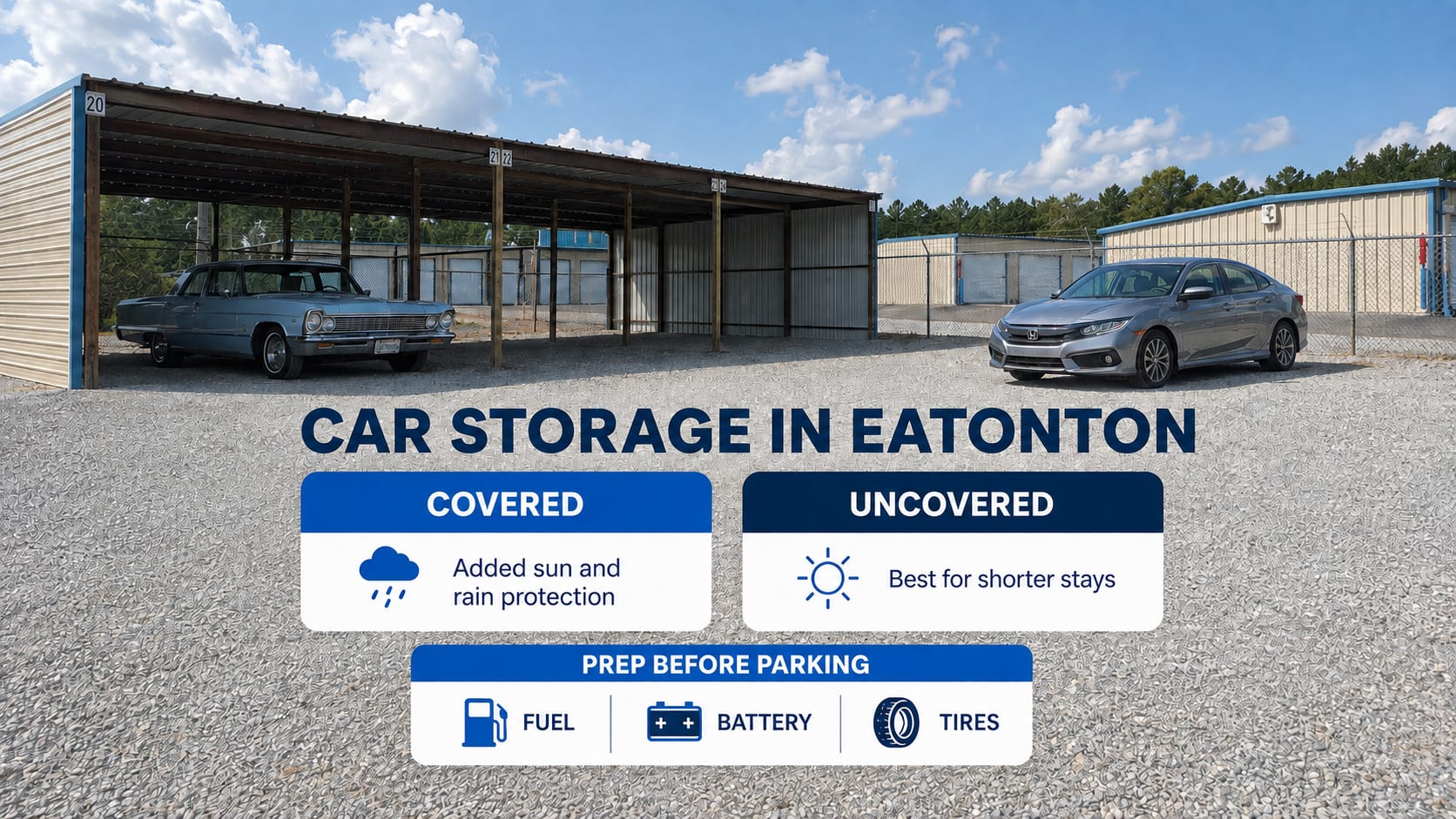
Car and Vehicle Storage in Eatonton, GA
Most people who look into car storage in Eatonton aren't storing a car they drive every day. They're storing the second car that doesn't fit in the garage anymore, the classic sitting under a cover in the driveway, or a vehicle registered under Georgia's antique tag that legally shouldn't be driven daily in the first place. Each of those situations changes what actually matters about where the car sits for the next several months, and none of them are solved by the same generic checklist.
At a Glance
- Store Southern offers standard 10x25 parking spaces plus extended 12x25 through 12x40 spaces for larger vehicles, both covered and uncovered.
- Covered parking is worth the added cost for anything stored more than about two to three months; for a shorter stretch, uncovered is usually fine.
- Georgia's antique vehicle tag requires the car to be at least 25 years old and restricts it to occasional, not daily, use, which is exactly the situation storage is built for.
- Gated keypad access and 24 hour video surveillance cover every parking space at Store Southern's Eatonton location.
- Preparing a car properly before storage (fuel, battery, tires) matters more than which storage type you choose.
The HOA Problem Nobody Plans For
A lot of car storage decisions in Eatonton start the same way: a homeowner buys a second vehicle, a project car, or something the household needs less often, and the driveway or garage runs out of room. If the property is inside an HOA, this often isn't just a space problem. Many HOAs restrict what can sit in a driveway long term, particularly anything that looks unused, uninsured for the road, or partially disassembled. Rather than negotiate that with a homeowners association, moving the vehicle to a facility with defined parking spaces sidesteps the argument entirely.
This is different from moving a boat or RV off the property, which is usually about size. A car or truck fits in most driveways just fine. The reason it ends up in storage is more often about what a neighbor or an HOA board thinks it should look like sitting there for months at a time.
Georgia's Antique Tag Changes the Math
Here's a detail that's easy to miss and genuinely changes the decision for a specific group of owners. Georgia issues antique vehicle plates to cars at least 25 years old, and that tag comes with a real restriction: the vehicle is meant for occasional pleasure driving, car shows, club events, and maintenance trips, not daily transportation or regular commuting. Georgia's antique plate program applies that rolling 25 year window based on the vehicle's model year, so cars from the late 1990s and early 2000s are entering antique eligibility now, which is a wider group of vehicles than most people picture when they hear "antique car."
That restriction on daily use is worth sitting with for a second, because it means a meaningful number of Eatonton vehicle owners already have a car that, by law, isn't supposed to be driven regularly. A car that only comes out for a show or a weekend drive doesn't need to occupy a garage bay or a driveway spot year round, and it doesn't need daily weather exposure either. Covered storage at a facility fits that use pattern more naturally than a driveway does, since the car is coming out a handful of times a month at most, not every morning.
None of this applies if the vehicle carries a standard tag and gets driven regularly. A daily driver being stored temporarily during a move or a renovation is a completely different situation, closer to what's covered in how storage works during a move in Eatonton, where the storage window is weeks, not months, and covered parking matters less.
Covered Versus Uncovered, Briefly
Store Southern's RV, car, and vehicle storage page covers the actual space sizes and covered versus uncovered pricing in detail. As a rule of thumb for a car specifically: under two to three months, uncovered is a reasonable and cheaper choice, since sun and weather haven't had time to do visible damage yet. Past that window, covered parking starts earning its cost back against Georgia's sustained summer UV, which is the more relevant tradeoff for a car sitting still for a long stretch rather than one being loaded and unloaded like an RV or boat.
One thing worth knowing regardless of covered or uncovered: a roof blocks direct sun and rain, but it doesn't touch humidity, which reaches a car under cover the same way it reaches one in an uncontrolled garage. That means the fuel, battery, and tire preparation below matters the same either way.
Preparing the Car Actually Matters More Than the Parking Type
Search around for car storage advice and nearly every source, from repair shops to insurance companies to online forums, converges on the same core steps, because the mechanical reality doesn't change based on where the car sits. A few of these are worth walking through in more detail than the average checklist gives them.
Fuel and the Tank You Don't Think About
A mostly empty gas tank invites condensation, which introduces water into the fuel system. A full tank with a fuel stabilizer added prevents that and also slows the fuel from degrading over months of sitting. If the car is stored longer than about six months, plan on draining and refilling with fresh stabilized fuel rather than assuming the original tank is still good.
The Battery Is the Part Most Likely to Fail
A car battery left connected in a vehicle that isn't started for weeks will drain, and repeated deep discharges shorten its life even after it's recharged. Disconnecting the battery stops that drain entirely. A battery tender, a low current charger designed to maintain rather than fully charge, is the better option if the car needs to stay drivable on short notice, since it keeps the battery topped off without the hassle of reconnecting terminals every time.
Tires Take the Longest Kind of Damage
A tire holding a car's full weight in one spot for months develops flat spots, more of a factor than most owners expect. Inflating tires to the upper end of their recommended pressure before storage reduces this. For genuinely long term storage, some owners put the car on jack stands to take weight off the tires entirely, a bigger step than most vehicles stored for a normal few month stretch actually need.
Pests Find Cars the Same Way They Find Anything Else Left Alone
A parked car is an appealing spot for rodents looking for a dry place to nest, particularly around the engine bay and under the seats. Steel wool packed loosely around exhaust openings and the air intake, along with keeping the interior free of food wrappers or crumbs, cuts down on this considerably. Store Southern's parking spaces include pest control across the property, which addresses the surrounding area but doesn't replace prepping the vehicle itself.
Insurance Doesn't Automatically Follow the Car Into Storage
A detail that's easy to overlook: storing a car doesn't mean insurance requirements disappear, and it also doesn't mean full coverage is automatically the right call for the storage period. Georgia requires liability insurance to operate a vehicle on public roads, but a vehicle that's genuinely parked and not being driven can often have its liability and collision coverage suspended in favor of comprehensive only coverage, which still protects against theft, fire, or weather damage at a lower premium. This is a conversation with an insurance provider, not a facility policy, but it's worth having before assuming the existing policy is either fully necessary or fully expendable during a storage stretch.
For antique tagged vehicles specifically, classic car insurance policies are common and often carry lower premiums than standard coverage, sometimes with agreed value terms rather than standard depreciation. Since antique tagged vehicles are already restricted from daily use, this pairing, antique tag plus classic car coverage plus covered storage, tends to fit together more naturally than trying to insure and register an occasionally driven car the same way as a daily driver.
What This Actually Comes Down To
A daily driver needing temporary space during a move or a renovation is a short term uncovered parking situation, and the same logistics that apply to a household move apply here too. A second vehicle displaced by an HOA's driveway rules, or a classic or antique tagged car that's legally restricted from daily use anyway, is a different and longer term situation where covered parking, proper fuel and battery prep, and a conversation with an insurance provider about coverage during storage all matter more than they would for a two week gap.
FAQs About Car and Vehicle Storage in Eatonton, GA
Is covered or uncovered parking better for storing a car?
For under two to three months, uncovered is a reasonable and cheaper choice. For longer storage, covered parking protects against Georgia's sustained summer sun and reduces paint and interior fading, though it doesn't address humidity the way a climate controlled unit would.
Can I store a car with an antique Georgia tag?
Yes, and it's a common fit. Georgia's antique tag already restricts the vehicle to occasional rather than daily use, so storage suits how the car is actually driven rather than working against it.
Should I disconnect my car's battery for storage?
For storage longer than a few weeks, yes, or use a battery tender to maintain the charge without fully disconnecting it. A battery left connected in an unused car will drain and lose lifespan from repeated deep discharges.
Do I still need insurance on a stored car?
Georgia requires insurance to operate a vehicle on public roads, but a genuinely parked vehicle can often move to comprehensive only coverage rather than full liability and collision, which lowers the premium while still covering theft or weather damage. Confirm this directly with an insurance provider before making the change.
What size space do I need for a standard car versus a truck or larger vehicle?
Store Southern's 10x25 spaces fit standard cars, sedans, and small SUVs. Larger trucks, trailers, or vehicle combinations typically need the extended 12x25 through 12x40 spaces.
Ready to store your vehicle? Store Southern is at 993 Martin Luther King Jr Drive in Eatonton, with covered and uncovered parking sized for everything from a sedan to a full trailer combination, gated access, and video surveillance across the property. Reach out to check current space availability and pricing for the size you need.